
DBPR Highlights 2025 Accomplishments
The January 7, 2026 release is reproduced below.
Florida DBPR Highlights 2025 Accomplishments that Protect Floridians and Support a Growing Economy
Consumer protection, enforcement, modernization, and more than $730 million supporting key statewide priorities.
TALLAHASSEE, Fla. – The Florida Department of Business and Professional Regulation (DBPR) today released its 2025 accomplishments, showcasing major gains in consumer protection, enforcement of Florida law, government efficiency, and economic growth. DBPR advanced Governor Ron DeSantis’ priorities by holding bad actors accountable, modernizing services, reducing costs for licensees, and supporting jobs and investment throughout the state.
“In 2025, DBPR demonstrated that strong consumer protections, a dynamic economy, and responsible stewardship of taxpayer dollars go hand in hand,” said DBPR Secretary Melanie Griffin. “From shutting down unsafe and unlicensed operations to delivering savings, supporting workforce education, and streamlining licensing processes, our agency delivered measurable results for Florida families, businesses, and communities.”
More Than $730 Million Impacting Floridians Throughout the State
DBPR serves as a significant conduit for funding that supports healthcare, research, local governments, and key statewide initiatives. This year, more than $730 million was disbursed to key industries that benefit Floridians every day.
Tax revenues from DBPR-administered cigarette and alcoholic beverage tax and licenses helped local governments strengthen Florida’s healthcare safety net. Funding expanded access to medical care, supported cancer and neurological care, and fueled cutting-edge research, allowing Floridians to access top-tier treatment throughout the state.
In addition to supporting healthcare and research, DBPR reduced costs for Florida’s professionals by implementing a 50% professional license fee reduction through June 30, 2025. This initiative saved licensees $24.1 million, reflecting the administration’s commitment to lowering barriers to work and supporting the state’s workforce.
To illustrate the broad impact of these tax revenues and funding initiatives, here’s a breakdown of how the more than $730 million was allocated across key sectors and programs:
$20,332,270 provided in beverage license revenue to cities and counties.
$38,425,800 allocated to Moffitt Cancer Center.
$47,908,225 allocated to the Agency for Health Care Administration (AHCA) Public Medical Assistance.
$1,717,228 provided to the Florida Department of Health Biomedical Research.
$585,282,511 allocated to the AHCA Healthcare Trust Fund.
$10,000,000 provided to the University of Miami (UM) Sylvester Cancer Center.
$10,000,000 provided to the Mayo Clinic Cancer Center.
$5,000,000 provided to the University of Florida (UF) Health Shands Brain Immunotherapy Clinic.
$5,000,000 provided to the UF Health Norman Fixel Institute for Neurological Diseases.
Additional DBPR program transfers supported agriculture, education, and family services:
$434,790 provided to the Florida Department of Agriculture and Consumer Services (FDACS) Viticulture Program, supporting Florida’s grape and wine industry.
$147,618 (10% of tobacco permit revenues) transferred to the Florida Department of Education, helping fund education initiatives.
$300,000 in catering license fees provided to the Florida Department of Children and Families, supporting critical social services.
$4,352,242 paid through the Florida Homeowners’ Construction Recovery Fund in Construction Industry Licensing Board Recovery Claims, assisting homeowners harmed by bad actor licensed contractors.
$192,857 awarded in Certified Public Accountants (CPA) Clay Ford Scholarships to future CPAs, strengthening the state’s professional talent pipeline.
$1,017,782 awarded in School-to-Career Grants (Division of Hotels & Restaurants) to support hospitality education in Florida schools.
$76,740 from lodging-related fines provided to the Florida Alliance to End Human Trafficking, bolstering anti-trafficking efforts.
Consumer Protections and Education Initiatives
The Division of Alcoholic Beverages and Tobacco (ABT), nationally recognized as the Innovative Alcohol Law Enforcement Program of the Year for its innovative efforts to combat a wide array of age-restricted products and safeguard children and the public, led some of the most consequential public-safety operations in its 92-year history. In 2025:
ABT conducted a statewide nitrous oxide enforcement initiative targeting unlawful sales at licensed premises. In September 2025, this effort resulted in the felony arrest of 75 individuals, with additional suspects still outstanding, after undercover agents were offered nitrous oxide canisters and instructed on how to use them to get high.
ABT implemented a historic enforcement initiative targeting harmful hemp products sold to minors, conducting more than 2,798 hemp product compliance checks and identifying 141 violations for sales to underage individuals, as well as numerous locations operating under unsatisfactory conditions.
Through Operation 8 Ball, a joint initiative led by the Miami District Office with multiple local, state, and federal partners, ABT Special Agents identified illegal “B-girl” activity, possible narcotics violations, prostitution, illegal gambling machines, and potential human trafficking or labor exploitation. The operation resulted in six arrests, including business owners and managers, identification of six additional subjects for potential deportation, and seizure of illegal gaming equipment and records as potential evidence in labor exploitation and trafficking investigations.
ABT also made youth access enforcement a daily priority. During calendar year 2025, sworn ABT agents conducted:
5,983 alcoholic beverage compliance checks, identifying 423 violations for sales of alcoholic beverages to persons under 21.
5,217 tobacco product compliance checks and 278 violations for sales of tobacco products to persons under 21 identified.
1,828 nicotine product compliance checks and 183 violations for sales of nicotine products to persons under 21 identified.
2,798 hemp product compliance checks and 141 violations for sales of hemp products to persons under 21 identified.
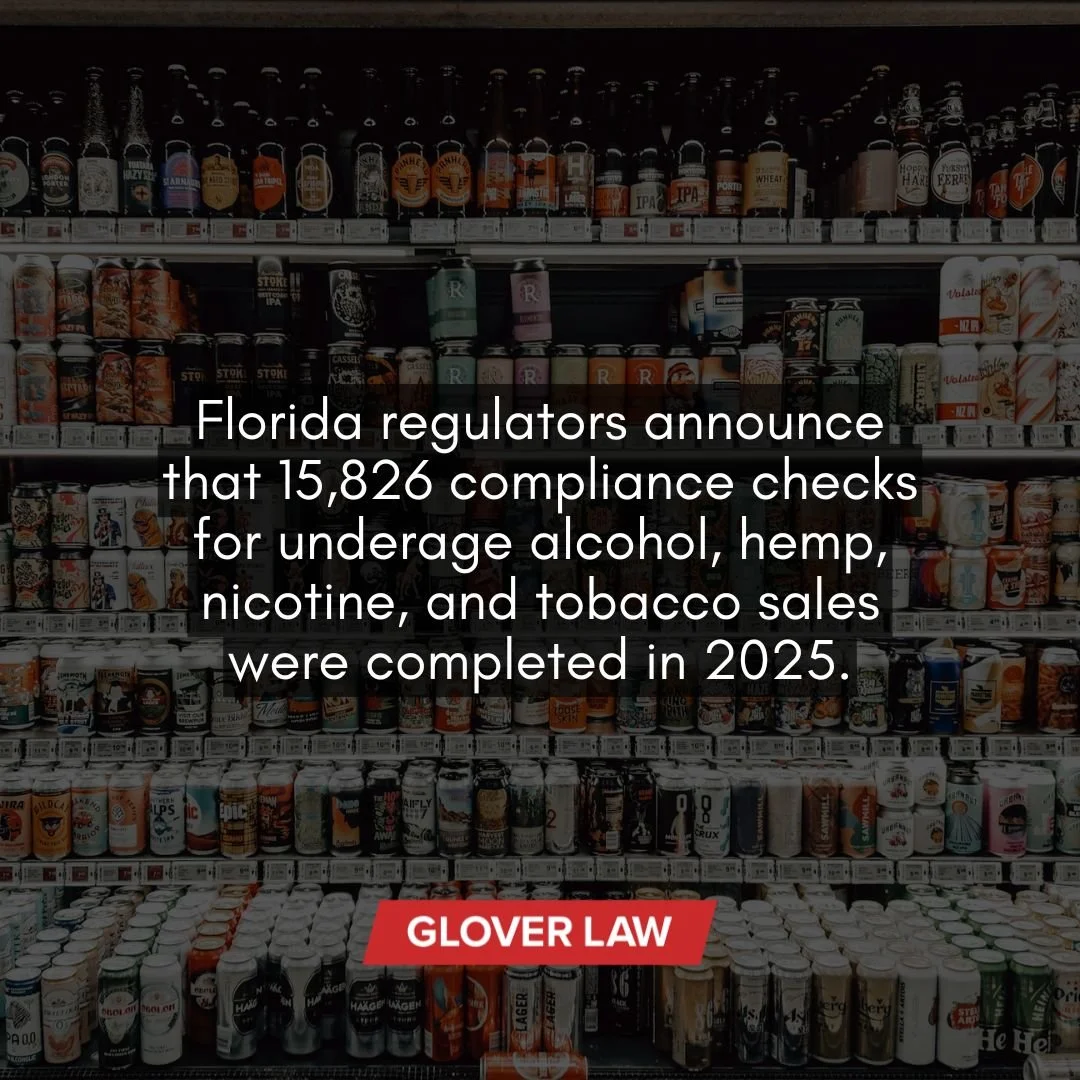
In total, ABT completed 15,826 compliance checks, finding 1,025 violations for underage sales and flagging additional locations for unsatisfactory conditions or closure. These efforts keep age-restricted products away from minors.
ABT’s anti-exploitation operations identified more than 500 trafficked women and rescued minors from labor exploitation.
ABT also reinforced the integrity of the licensing system by prosecuting a $4.2 million alcohol license fraud case and implementing additional security measures to prevent future schemes.
ABT became a certified 287(g) immigration enforcement agency, with all sworn personnel supporting federal operations statewide and working 375 shifts (2,894 hours) to help remove criminal aliens and dismantle illicit networks.
In November 2025, ABT leadership presented at the NLLEA national conference on Florida’s investigative model for hemp products sold to underage customers. Other states, including Texas, are now working to develop programs modeled on Florida’s hemp and vape enforcement initiatives.
ABT’s elite teams train law enforcement agencies nationwide, developing best practices adopted in other states.
ABT maintained statewide presence across 12 district offices with 106 sworn officers and 56 inspectors, reinforcing its legacy as Florida’s second-oldest state law enforcement agency.
The Division of Hotels & Restaurants remitted $76,740 in fines to the Florida Alliance to End Human Trafficking and completed over 98% of required public food service and lodging inspections in fiscal year (FY) 2024–25, maintaining strong oversight.
The Division of Condominiums, Timeshares and Mobile Homes (CTMH) helped condominium owners and boards adapt to new requirements, which included creating mandatory online accounts under HB 913 (2025). By November 30, 2025, over 16,104 associations had created required accounts.
Recognizing that legal changes can be complex for everyday Floridians, CTMH expanded its education and direct engagement with condominium constituents. To help explain new requirements under HB 1021 (2024) and HB 913 (2025), the Division achieved the following:
Hosted or participated in 92 educational sessions, reaching over 41,000 attendees.
Attended 98 meetings statewide after launching an online process for unit owners to request Division participation.
Enabled scheduling of in-person and virtual appointments with Division investigators and the Ombudsman’s Office.
Expanded the free Board Member Certification course to English and Spanish, increasing statewide accessibility.
DBPR continued to crack down on unlicensed and unlawful activity to protect consumers, maintain fair markets, and hold bad actors accountable.
The Division of Regulation maintained a robust and broad enforcement footprint:
22,003 complaints processed and 2,658 enforcement actions completed, including citations, final orders, and administrative complaints.
4,853 Unlicensed Activity (ULA) complaints investigated, 2,026 ULA enforcement actions completed, 1,885 hotline calls, 7,614 ULA emails handled, and 853 sweeps, stings, and outreach activities conducted statewide within the ULA program.
The Division of Regulation also arrested an unlicensed individual posing as a veterinarian.
Working with National Association of State Contractors Licensing Agencies (NASCLA) member offices in Tallahassee, Jacksonville, Tampa, Orlando, Fort Myers, West Palm Beach, Fort Lauderdale, and Miami, the Division accomplished the following:
Conducted 50 coordinated sweeps, performed more than 609 license checks, and initiated over 95 cases through the ULA Unit.
Held 17 outreach events, engaging more than 285 individuals about the importance of hiring licensed professionals.
Identified 13 unlicensed individuals advertising regulated electrical and construction services through a major enforcement effort.
DBPR also emphasized early dispute resolution to protect consumers and reduce legal costs. Through its Alternative Dispute Resolution (ADR) program, the Department achieved the following results:
167 successful mediations completed.
$1,566,118.26 recovered through mediation.
$169,338 in additional savings achieved via mediated settlement.
DBPR’s statewide public education campaign on unlicensed activity generated $2.56 million in media value from a $300,000 investment and over 24 million impressions, raising awareness of the importance of hiring licensed professionals.
To further amplify its presence, DBPR developed a unified brand identity for the Unlicensed Activity (ULA) program, applying the new look across print materials, social media, presentations, and event displays, including a wrapped mobile unit. In 2025, the ULA Unit deployed its first mobile command center, equipped with power, internet, and on-site resources to support enforcement and outreach directly in communities, including during post-storm operations.
The Division of Real Estate complemented this effort with targeted television commercials encouraging homeowners and future buyers to verify licensure and report suspected unlicensed real estate activity.
The Division of Real Estate reviewed 5,813 complaints, completed 1,417 investigations, and increased inspections and audits, identifying over $440,000 in escrow shortages and prompting remedial action.
The Division issued Emergency Suspension Orders against MV Realty licensees for deceptive practices and maintained an ESO for fraudulent transactions by another licensee. In 2025, the Division also passed a federal audit for appraisal oversight compliance.
The Division of Drugs, Devices and Cosmetics (DDC) investigated reports that Gulf World Marine Park was keeping endangered animals in inhumane and hazardous conditions. DDC compiled over 1,100 pages of evidence, and Gulf World agreed to surrender its license and to never reapply for another license in Florida again.
Modernizing Licensing and Cutting Red Tape
DBPR continued to modernize operations and reduce regulatory friction, keeping Florida pro-business while upholding high standards.
The Division of Hotels & Restaurants earned a 2025 Government Productivity Award for implementing an electronic return-receipt for certified mail, reducing paper use and improving tracking. The Bureau of Elevator Safety rolled out fully electronic inspection report submissions, streamlining processes.
CTMH migrated key condominium reporting to online accounts under HB 913 (2025), simplifying compliance and improving data accuracy. New online tools also provide direct access to meeting requests and appointments.
The Division of Professions implemented several process improvements to speed licensure and adjudication:
The Board of Cosmetology delegated certain endorsement application approvals to staff when applicants cannot document older education records, reducing the need for variance or waiver petitions and shortening the path to licensure.
The Board of Cosmetology and the Barbers’ Board each added four conference calls between in-person meetings to expedite application decisions and clear disciplinary backlogs.
The Building Code Administrators and Inspectors Board (BCAIB) adjusted its Preliminary Application Review Committee (PARC) process so that in May 2025, 202 applications were reviewed and 153 (approximately 76%) were approved through PARC and moved forward up to four weeks earlier than under the prior process, with only complex reviews going to the full board.
The Bureau of Education and Testing (BET) modernized systems for construction contractors by implementing a new GPA exemption process—allowing BET to proactively add exemptions to applicant profiles—and for community association managers and firms by partnering with the Division of Technology to implement new licensure reporting and continuing education requirements under HB 1203 (2024), ensuring accurate category-level continuing education tracking.
The Division of Regulation saved money by hiring a part-time CPA and bringing Employee Leasing Program audits in-house, reducing vendor reliance.
The CPA Division launched a fully online process for continuing education course approvals, streamlining submissions for providers.
The Division of Real Estate redesigned licensure applications, modernized its website, upgraded equipment, and implemented automated reminders to accelerate enforcement.
The Division of Real Estate successfully concluded the HB 1091 (2023) real estate licensure fee holiday, ensuring a smooth return to standard fee structures after two years of 50% reductions, contributing to the overall $24.1 million total in professional license savings delivered across DBPR.
ABT cut average processing time for temporary alcohol licenses from 22 days to 2, allowing events and businesses to launch faster while maintaining oversight.
Responsibly Growing Florida’s Economy and Talent Pipeline
DBPR’s work supports not just safe markets, but also a growing economy and a strong workforce.
The Division of Hotels & Restaurants continued investing in the next generation of hospitality workers in 2025:
255 schools received Hospitality Education Program grants.
Over 46,000 high school students received culinary and hospitality training through these grants.
$1 million School-to-Career investment in hospitality education provided.
The Florida Athletic Commission helped cement Florida’s status as a national leader in combat sports. In 2025, the Commission accomplished the following:
2,988 licenses issued supporting athletes, promoters, and event personnel.
Seven new promoters approved, creating more event opportunities and economic activity.
National rankings achieved: third in boxing among 55 reporting jurisdictions and fifth in mixed martial arts among 122 jurisdictions, based on data from U.S. and First Nation commissions.
The CPA Division also contributed to Florida’s professional leadership. The CPA Division’s 2025 achievements included:
4,132 applications processed, a 4% increase over 2024.
188 investigations completed, with an average completion time of 48 days.
$192,857 in CPA Clay Ford Scholarships administered, supporting aspiring Certified Public Accountants (CPAs) who will serve Florida’s businesses and citizens.
Awareness of unlicensed activity promoted through print and radio advertising and a webinar with more than 350 registrants.
As Florida continues to grow, the safety and resilience of its buildings remain a top priority. The Florida Building Commission and related programs within the Division of Professions advanced key initiatives in 2025:
Approved the Building Safety Program, establishing minimum requirements for mandatory milestone inspections in the 2023 Edition of the Florida Building Code, an important safeguard for aging structures.
Eight informational and training webinars hosted through the Office of Codes and Standards to educate stakeholders on the Building Safety Inspection Program and the Building Safety Inspection Reporting Form.
Adopted a technical amendment reverting the definition of “Wind-Borne Debris Region” to the 2020 Florida Building Code definition, ensuring alignment with Florida’s risk profile.
1,500 model code changes reviewed and 658 approved for inclusion in the 2026 update to the Florida Building Code, 9th Edition (2026) in the first step; 556 proposed code modifications from the public reviewed and 345 recommended for approval for the Commission’s consideration at its December 2025 meeting in the second step.
Completed hurricane resistance research in FY 2024–25 on standards for wind-driven rain intrusion through sliding glass door track systems and on wind-borne debris regions in ASCE 7-22, ensuring code requirements reflect current science.
2,264 applications for the State Product Approval Program approved, 29 accessibility waivers granted, 46,098 insignias under the Manufactured Buildings Program issued, and 34 advanced training courses under the Commission’s Education Program approved, all of which support safe construction and resilient growth.
###
The Department of Business and Professional Regulation licenses and regulates nearly 1.7 million businesses and professionals in the State of Florida across more than 30 fields of industry. The Department’s mission is to license efficiently and regulate fairly. For more information, visit MyFloridaLicense.com.